

Your words can make or break your conversions on your landing page and website. I can confidently say this as a website copywriter who has worked on hundreds of them.
But what’s the difference? Aren’t both of them online pages meant to showcase your business and what you offer? Many people often confuse website and landing page copy, but we’re here to clear the air.
In this article, we’ll iron out the purpose of a landing page copy vs a website copy, the differences between the two, and why both pages matter in your marketing process as a small business in Perth.
TL;DR (Summary): The difference between a Landing Page Copy vs. Website Copy is intention. Landing pages are made to convert your visitors into paying customers, while website copy is more informational. Both should focus on the customers’ pain points and how you can solve them.
What Is a Website Copy?
Website copy is any copy that’s written on your website. This includes your headlines, body copy, bullet points, and call to action. Your website generally contains content that showcases everything a potential customer should know about your company.
Websites typically have multiple informational pages, including your Home page, product and service pages, pricing information, an About Us page, a career page and more. Copies on this page are often informative in nature with the goal to build trust, improve brand discoverability online and the products and services you offer to your customers.
What Is A Landing Page?
Landing pages are meant to serve a specific purpose. They have minimal navigation and are usually tied to an ad or campaign, making them short-term in nature. Unlike the copy on your website, the copy on landing pages is usually written persuasively, generating conversions or leads that direct your audience to your main website.
Now that we understand what a landing page and a website are, let’s look at the differences between the copies on both pages.
Difference Between Landing Page Copy and Website Copy
| Aspect | Landing Page Copy | Website Copy |
| Goal of copy | Conversion-focused | Information-focused |
| SEO writing | Less important | Crucial for ranking |
| Tone | Urgent and persuasive | Consistent and informative |
Why Does it Matter for Small Businesses?
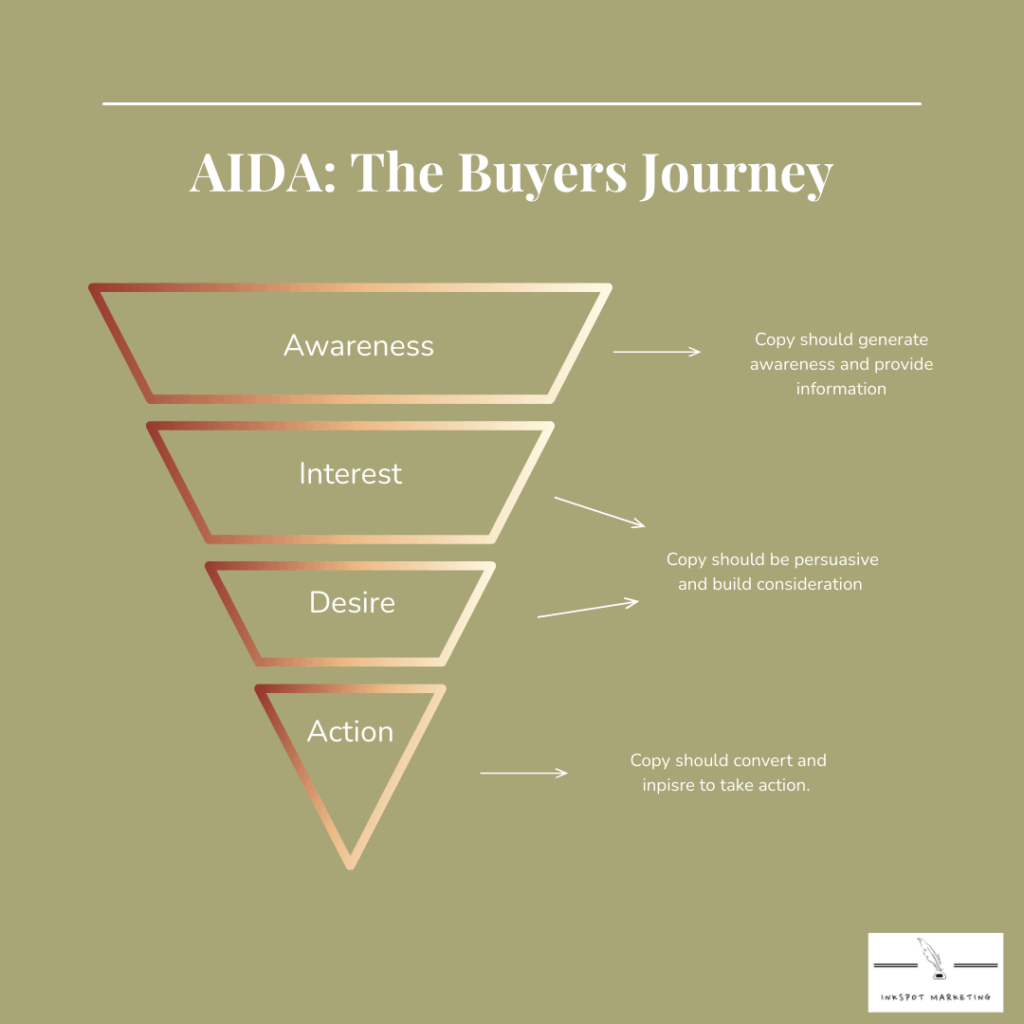
When you first write your copy, you’ll need to set a goal. Do you want to inform or convert? This depends on what stage your buyers are in their consumer journey – we call this AIDA.
AIDA is the mantra every business owner should be familiar with. This framework helps you map out your customer journey and target your marketing efforts to achieve specific goals, which is why a copy on your landing page or website should be specific in its purpose as well.
For example, using SEO keywords and adding relevant information about your business is perfect for your website copy. In contrast, landing page copies should be persuasive to help you get the best return on investment through conversions and leads.
In saying that, you can also create a landing page copy that is highly informational, especially if your product is technical in nature. So consider your product and your business before writing.
Common Landing Page and Website Copy Mistakes
If you already have a landing page and a website but still don’t see the results you want, check if you’re making some of the following mistakes.
Mistake 1: Wasting money on copywriting without understanding your audience
Understanding your audience’s needs and pain points should be your first step in your whole marketing process.
So to get the most out of any copywriter you’ve hired, you’ll need to ensure you and the copywriter are aligned on the profile of your audience. That will make it easier to personalise the copy on either your landing page or website to your audience.
Mistake 2: Overloading landing pages with navigation links
Navigation tools are meant to guide your audience through your page, but overloading them can lead to a bad user experience, bad SEO, and poor web usability. This can distract the readers from the goal for each page.
Be sure to organise your page neatly, with navigation links strategically placed without diluting the purpose of each page. You could also set limits on the number of navigation links per page and introduce menus or search functions for content-heavy pages such as FAQs or blogs.
Mistake 3: Ignoring SEO on main webpages
Imagine reaching your audience without paying a cent for paid ads. That’s where an SEO copywriter comes in – we help your audience find you online just as they need your product/service.
Your landing page and website copy must include relevant keywords (based on prior research) on your main webpages. SEO is highly technical, which is why I work with an SEO specialist on all my content.
Mistake 4: Misaligned messaging between your landing page and paid ads
If your audience has seen your product ads, your landing page should focus on the same thing, too. Any misalignment would leave your audience confused and dissatisfied, resulting in bounce rates and lower conversions.
For example, I’ve worked with a chiropractor to re-create a landing page that runs directly from a Facebook ad. The original advertisement mentioned sciatica pain, which was not mentioned at all in the landing page. I’d addressed this and made it the main header in their landing page, which made it more cohesive overall.
Key Takeaway
There is no such thing as one-size-fits-all content when it comes to writing website copy. Your landing page and website serve two different purposes. Hence, your marketing strategies and copy must follow suit if you’re going to funnel your audience seamlessly through your marketing process.
If you’re looking disappointedly at your website or landing page, it’s never too late to start over. Reach out to Inkspot Marketing to learn more about our website copywriting services. No obligations.

Frequently Asked Questions
What’s the main difference between landing page copy and website copy?
Landing page copy is more strategic and directional, made to drive a single action (sign up, buy, download, register, etc.). In contrast, website copy is created to inform, educate or help users navigate and learn about a brand. It may contain About Us, Product, Pricing, Blog, Career and more.
Why do small businesses need both a landing page and website copy?
Both pages serve different purposes to drive growth. Landing pages are made to drive conversions, while website copy is made to build trust and credibility.
If you’re running ads online, direct your customers to a landing page that focuses on selling. Your landing page will then direct your customers over to your website, where they can learn about your brand.
At the end of the day, it depends on the goal you are trying to achieve. Speak to us to gain a better understanding of your customers and what your brand needs.
Does landing page copy affect SEO?
Yes, it could. You should consider improving page load speed, adding schema, and other technical SEO enhancements for your website page. You may also add relevant keywords, but with a focus on conversions, not SEO. What you are looking for with your landing page is your money’s worth from ad spending, which is quality conversions.
Can I use the same copy for my website and landing page?
You can only use a little of your copy on the website on your landing page, and you should limit duplicate content. A landing page should always be tailored to the ad your customer just saw. You wouldn’t want your customer reading an ad, but arrive on a landing page that has no relation to the ad they just saw.
How does professional copywriting help small businesses in Perth?
Professional copywriting doesn’t just mean writing. It also means working with you to understand your customers and develop a strategy to personalise your messaging for maximum conversions and revenue. As a small business with little time, it helps to get an extra hand in marketing.

Denise Choong
Author
Denise is a small business marketer and copywriter in Perth, and the founder of Inkspot Marketing. With over 10 years of marketing experience, she’s worked with businesses in SaaS, finance, NDIS, medical, hospitality, and other industries.
Denise is passionate about using sound marketing practices to help business owners see tangible results in their investment. More than quick short-term wins, she works closely with businesses and marketing teams to see long-term, lasting growth.