


Looking for an SEO package that’ll deliver results without burning through your budget? Welcome to an honest part of the internet where I’ll tell you what you should spend on in SEO, and what you shouldn’t.
As a small business in Australia, you don’t have the budget like the big guys. You’ve probably even hired an SEO agency or hired an SEO copywriter on one of those online platforms. And I can only guess where it went.
“We’ve been doing SEO for months, but no leads.”
“The agency sends reports with pretty graphs, but nothing’s changed.”
“The agency doesn’t send me reports at all.”
Here’s my take. Yes, SEO takes time, consistency, and patience. But you don’t need to be spending $5k on a retainer just to see results.
As someone who has worked in marketing and seen plenty of SEO done right and wrong (yes, even by marketing agencies), here’s what you actually need in your SEO package as a Perth small business, and what you don’t.
TL;DR (Summary): A good SEO package has a keyword strategy, good quality content, local and technical SEO support, competitor research, and clear reporting. Small businesses do not need fancy SEO content tools, complicated reports, and excessive AI-written blog posts. The best SEO packages for small businesses in Perth are affordable retainers that provide results while staying within budget.
What Are SEO Packages?
An SEO package is a bundle of Search Engine Optimisation services that are aimed at improving your website’s visibility in search engines like Google. Some of the tasks included in this package are keyword research, competitor analysis, backlink building, technical SEO, and content creation.
Plenty of marketing agencies bundle everything SEO together into monthly or project-based retainers (including us at Inkspot Marketing).
Here are the three common packages you’ll see as a business in Perth:
- Monthly retainers: Pay a set fee each month for ongoing SEO work
- Project-based: One-time fee for specific deliverable (like a website audit/competitor analysis)
- Hourly rates: Pay for time spent on your SEO (this is common when you hire a freelancer)
What Should Your Small Businesses Actually Want from SEO?
Let’s look at the real reason you’re doing SEO (i.e. your goal). Most small business owners want these 4 things when you do SEO:
- Leads, not just visitors: More people contacting you, booking calls, or buying from you
- Visibility on customer searches: Showing up on Google when someone searches “plumber near me” or “best accountant in Perth”
- Consistent inquiries or bookings: A steady stream of customers finding you on Google
- ROI clarity: Knowing whether your SEO spend is actually making you money
There’s a good way to do this and a bad way. I’ve seen plenty of marketing agencies take shortcuts in their SEO, whether it’s using tools that they don’t need, creating generic content that ranks for nothing, or providing reports that nobody understands.
So here’s what to look for in a small business SEO package.
What You Actually NEED in an SEO Package
Here are my thoughts on the nine necessary SEO tasks that you should have in an SEO package.
1. Keyword Strategy
Good SEO is about having a plan for your keywords and understanding the behaviour behind the keywords. Keywords are essentially what customers type into Google, and they can be either informational (browsing for information), navigational (finding a specific page), commercial (comparing brands), or transactional (ready to buy).
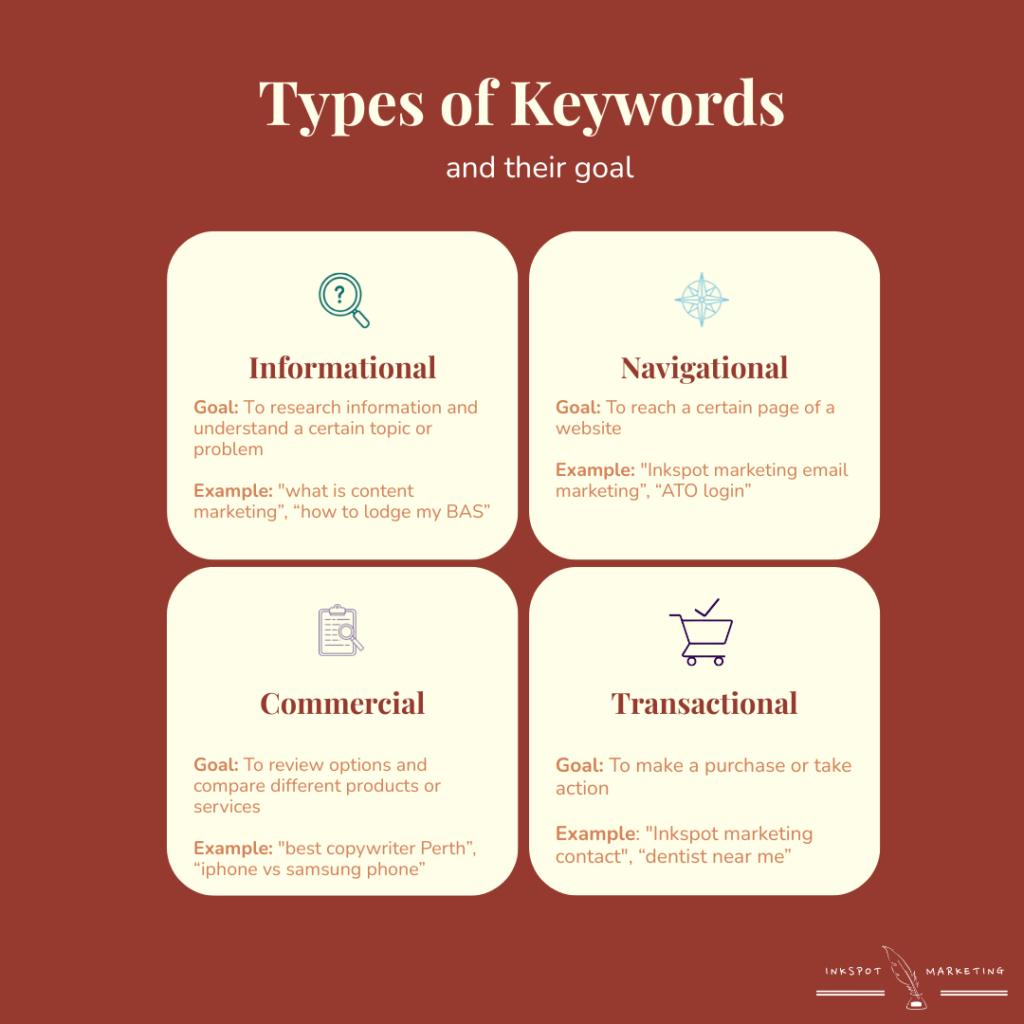
You need an SEO who understands keyword strategy, such as:
- Understanding the difference between the keyword types and how to structure content for them
- Target local keywords if you’re a local business
- Prioritise long-tail or easy-to-rank keywords over broad, competitive terms
- Audience research. What are they actually searching for? What problems are they trying to solve?
Why does this matter? SEO isn’t just chasing volume. If there’s no strategy, you’ll be spending money chasing a competitive keyword that you’ll probably never rank for, or you’ll be creating content that ranks for a keyword, but nobody reads it.
2. Website Optimisation
Most SEO packages don’t, but should, also prioritise good website content writing. Does the copy on your website convert? Is it written in a way that follows your audience’s psychology and erases their doubts about your business (you should always assume your potential customers don’t trust you at first)
Getting traffic to your website means nothing if visitors don’t take action. So your SEO package should include recommendations on how to achieve these:
- Clear CTAs: Every page should tell visitors what to do next (book a call, request a quote, contact you)
- Landing pages that convert: Not just informational pages, but pages designed to turn visitors into leads
- UX improvements: If your site is confusing or hard to navigate, people will leave
3. Technical SEO
Technical SEO is the process of optimising a website’s backend so that search engines can easily crawl and index its pages. In simple terms, it’s like putting up signboards on each and every page on your website so that Google knows it’s there and can read it easily.
If your website is slow, broken, or invisible to Google, all the keyword research and good content in the world won’t help. Here are some technical SEO tasks we typically see in an SEO package:
- Page speed optimisation: Making your pages load faster
- Mobile optimisation: Helping your site look good on mobile phones
- Schema markup: A technical fix that helps Google understand your content and show it in search results
- Indexing: Ensuring Google can actually find and index your pages
4. Content That Brings Qualified Traffic
Content should always be part of SEO, but so many agencies get this wrong. For SEO to be effective, you need content that shows your expertise, tells customers how you can solve their problems, and brings in people who are ready to buy.
Most agencies pump out generic blog posts or AI slop, and small businesses are left wondering why they don’t see results.
Here’s the thing: content should never be written by AI alone. AI can help with research or drafts, but if your agency is pumping out AI-generated content with no human strategy or editing, you’re wasting your money. Google can tell. Your customers can tell.
5. Local SEO (If You Serve a Specific Area)
If you’re a Perth business, local SEO is non-negotiable. It helps you attract customers near you and rank for keywords like “near me”. Unfortunately, so many small businesses and their agencies make mistakes with local SEO.
In an SEO package, local SEO optimisation can include these tasks:
- Google Business Profile optimisation
- Local keyword targeting
- Local citations and directory listings
- Encouraging reviews
6. Link Building
Backlinks refer to links from other websites to yours, and they are highly important for SEO. Be careful when you have this in your SEO package, and make sure that the agency or freelancer doesn’t use low-quality or irrelevant links on your website (otherwise known as black-hat tactics).
If an agency promises “50 backlinks in 30 days,” it’s a red flag. Backlinks should always be quality over quantity, and any shortcuts will be penalised by Google and derail all your SEO efforts.
7. Conversion Tracking & Real Reporting
Reporting is one of the most important aspects of SEO because it allows you to know which content is working, what pages are ranking, and if you need to change your content strategy.
Unfortunately, most agency reports are pretty difficult to understand, and too focused on impressions (how many people see your site) without actually seeing if those impressions actually turn into sales. If your agency only focuses on impressions, then your business gets no value from the SEO package.
8. AI Optimisation
Search is changing, with Google’s AI Overviews becoming more common in many search queries. Your SEO strategy needs to account for this and include content that’s structured for AI.
If an agency doesn’t at least have this on its radar, they are probably not keeping up with the times, and you’re unlikely to see any results.
9. Competitor Research
Competitor research is one of the fundamentals of SEO. It includes things like:
- Understanding what your competitors (other businesses in your niche) are ranking for
- Identifying gaps in their strategy that you can exploit
- Benchmarking your performance against similar businesses
Good SEO packages and teams find opportunities for your business, and also help you carve your own originality in the market.
What You DON’T Need (Or Should Be Careful Paying For)
Now let’s talk about what you don’t need in your SEO package. This might be controversial, and some SEO gurus might disagree – but it’s my honest opinion based on my years in the industry.
1. Guaranteed #1 Rankings
If an agency promises “guaranteed #1 rankings,” they’re either lying or using black-hat tactics that will get you penalised. No one can guarantee rankings because Google’s algorithm changes constantly.
Even if they do rank you #1 for a keyword nobody searches, it’s worthless. Always remember that if something sounds too good to be true, it probably is.
2. Bulk Backlinks Packages
Anyone can buy backlinks these days, but this has always been a controversial topic in SEO. Backlinks only work if they are from a high-quality website, and spammy directories can get your website penalised.
If someone is promising you 100 backlinks for $500, it’s probably a list of poor-quality sites. My recommendation is to always get one good backlink from an authoritative source, rather than hundreds of backlinks from poor sites. Here’s a good article on how to build high-quality backlinks for your site.
3. Excessive Blog Posting (Quantity Over Quality)
When it comes to content, quality beats quantity. 20 low-quality, AI-generated blogs won’t rank, and you’re better off with 2 genuinely useful, well-researched posts per month. Or a long-form content that can be used in a lead generation strategy.
However, do not leave your blogs empty for months or years. Google prefers updated websites, and it plays a big role in your SEO ranking.
4. Irrelevant Directory Submissions
If your agency is spending time submitting your business to 100 random directories, they’re wasting your money. Some directories have no authority, and some are quite obvious to Google as ‘backlink farms’.
Your business should be in relevant, high-quality directories only (like industry-specific listings or local business directories). In fact, being on local directories can help your local SEO.
5. Vanity Metrics Reporting
We’ve already touched on this, but here’s what fluffy reports look like:
- “Your impressions increased by 50%!” (Did it bring in customers?)
- “You’re ranking #1 for [obscure keyword]!” (Does anyone search for it?)
- “Your domain authority went up!” (Did you get more leads?)
Focus on business outcomes. While your SEO package should have reporting, your agency or freelancer delivering these reports should have your best interests in mind and actually care for where your business is going.
6. Overspending on Tools
Some agencies charge you extra for “premium tools” like SurferAI to write your blogs. As a small business, you’re better off choosing a simpler SEO package without all these inflated costs added to it.
I think these tools are good as guidance, but many agencies follow them too closely without using good judgment.
7. SEO for SEO’s Sake (No Strategy)
The worst SEO packages are the ones that optimise your site without understanding your business. This could mean:
- Building content without understanding your audience
- Having no content strategy
- Not focusing on good quality content
- Chasing rankings for keywords that don’t bring in customers
Even if this gets ranked (and that’s a big IF), what does it do for your branding? Do you actually get the leads you want? Or are you just attracting tyre-kickers?
8. Treating SEO Like a One-Off Thing
SEO is an ongoing effort between you and the SEO package provider. If an agency or freelancer promises “we’ll optimise your site, and you’re done,” they’re setting you up for failure.
You may have a good SEO foundation, but you won’t rank unless you do SEO regularly. This means building backlinks, releasing good content, and fixing any website issues or changes.
Good SEO is a long-term commitment.
Recommended SEO Package Structure for Small Businesses
As a small business, you need an SEO package that strikes the right balance between budget and quality.
You can’t afford $5,000 SEO packages, but the cheap freelancers may also not understand your brand and content.
So your best bet is to focus on a package that covers a set number of hours of SEO and content per week. For example, Inkspot Marketing has an affordable Content and Search package for small businesses that covers backlinks, ongoing content, technical SEO fixes, and reporting.
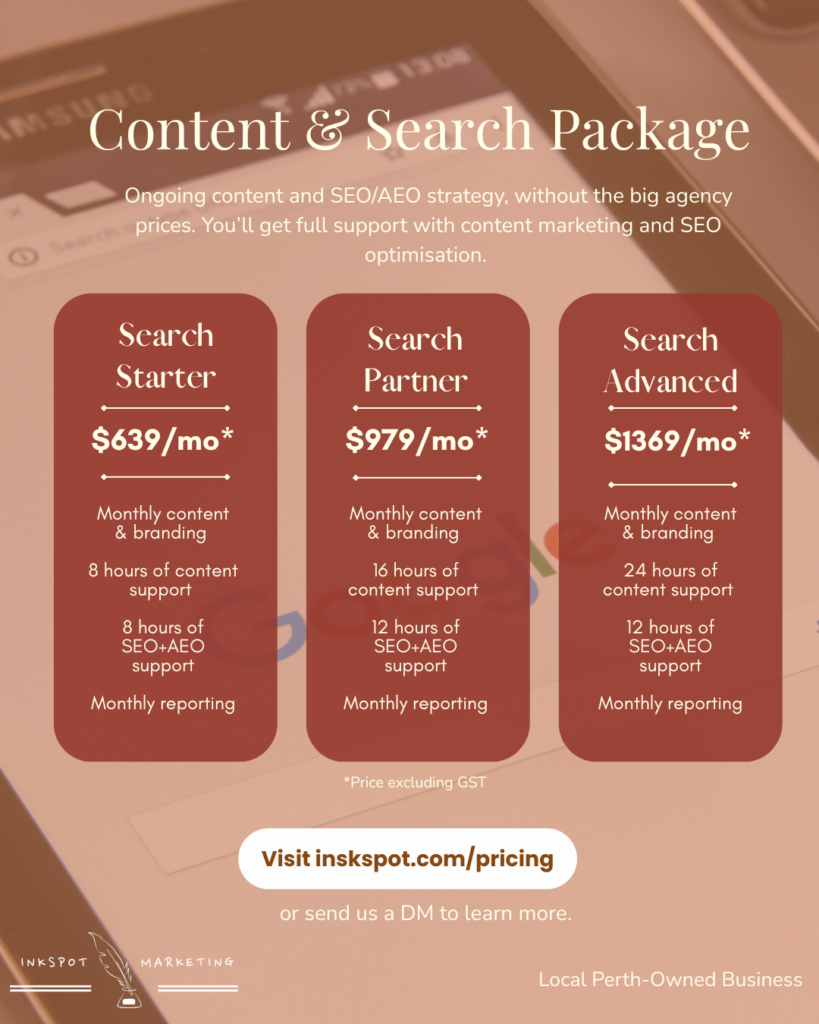
Here’s why our content works for small businesses:
- Each month, we prioritise and optimise your SEO tasks based on what needs attention the most
- Strategy is done by me (a local Aussie who understands your market)
- SEO execution is handled by an international Search specialist (which keeps costs down)
- You can scale up or scale down the packages, depending on where your business is at
- We cut all the fat, with no physical office and a remote location
- You have total control over which SEO tasks we do. If you’d like us to focus on Local SEO first, we’ll do that.
- Your SEO shifts from ticking a box to a performance-based one where we prioritise results.
Key Takeaway: What to Look for and What to Avoid
So in summary, here’s what your SEO package should have
- An SEO strategy that includes developing content your audience will love
- Clear deliverables on what you’re getting every month
- Keyword research and strategy
- Some understanding of AI optimisation
- Website and technical SEO optimisation
- Competitor research
- Clear, understandable reports
And here’s what your SEO package shouldn’t have:
- Promises guaranteed #1 rankings
- You have no idea what is being done
- Sends reports with no clear deliverables
- Uses black-hat techniques (poor quality links, keyword stuffing)
- Locks you into long-term contracts with no escape clause
- Focuses only on rankings, not conversions
- No understanding of your customers
Final Thoughts
When it comes to choosing an SEO package for your small business, always go for value over cheap shortcuts. Many of my clients have learned the hard way that cheap SEO can be harmful to their business in the long run.
The right package combines high-quality content, strong SEO practices, customer knowledge, and genuine care to help your business do well.
At Inkspot Marketing, our search and content packages are an affordable way for small businesses to get found online. If you’re a Perth small business looking for SEO copywriting services in Perth without the big agency price tag, let’s chat.
Frequently Asked Questions
What should an SEO package include?
A good SEO package should include keyword research, technical SEO implementation (schema markup, page speed, mobile optimisation), quality content, link building, and clear reporting. For small businesses, local SEO and Google Business Profile optimisation are also highly important, and must be included in the package.
How long does SEO take to show results?
Most businesses see initial traction within 60-90 days, but significant results (consistent leads and conversions) typically take 4-6 months. SEO is a long-term strategy, not a quick fix. You should always beware of agencies promising overnight results because they might be using tactics that will get you penalised, and this will be harder to rework.
Are cheap SEO packages worth it?
Cheap SEO packages are usually cheap for a reason. You get keywords that don’t match your audience, AI-generated content, useless backlinks, and no real strategy. You’re better off investing in a mid-range package that is locally delivered than wasting money on a cheap package that does nothing.
Can I do SEO myself?
Yes, but it takes time, plenty to learn, and a lot of effort. You’ll need to learn keyword research, technical SEO, content creation, link building, and analytics. For most small business owners, the time could be better spent elsewhere on their business. I’d suggest getting some knowledge about it (so you know what you’re doing) and hiring an SEO team to help you.
What to expect from small business SEO packages in Australia?
In Australia, small business SEO packages typically range from $500-$3,000/month, depending on scope and what you need done. You could hire a freelancer from Upwork to help you with your SEO, but remember that content is also a big part of SEO, and most SEO specialists aren’t skilled at writing content. This is why Inkspot Marketing’s Content and Search package works, because we combine the skills of an SEO specialist and a local content strategist.
What happens if I stop my SEO package after a year?
Your rankings won’t disappear overnight, but they will definitely go down over time. If you stop, expect your traffic and rankings to drop within 3-6 months. SEO is an ongoing effort, and you’ll need to consistently publish more blog posts and update your website pages in order to get on Google and AI answers.

Denise Choong
Author
Denise is a small business marketer and copywriter in Perth, and the founder of Inkspot Marketing. With over 10 years of marketing experience, she’s worked with businesses in SaaS, finance, NDIS, medical, hospitality, and other industries.
Denise is passionate about using sound marketing practices to help business owners see tangible results in their investment. More than quick short-term wins, she works closely with businesses and marketing teams to see long-term, lasting growth.