

Tired of posting on social media, writing a blog or two, and sending out emails without customers at your doorstep?
Perhaps it’s because you need a proper content marketing strategy. This is something I often do for my clients as a branding and digital marketing consultant. A content strategy will help you approach your target audience in a focused way without blowing your budget.
Read on to discover how our guide can help you to do this and ultimately bring in the customers.
TL;DR (Summary): To be successful in your content, you need a content marketing strategy. Firstly, understand who you are selling to, and find the sweet spot where your product or service can solve their problem. Come up with a brand tone of voice to sound the same on all platforms. Then, identify which platforms you want to be in and come up with a content calendar. Create well-researched, thoughtful content and track what’s working. Lastly, don’t forget to do some AEO/SEO work so that your content is visible.
What is a Content Marketing Strategy?
A content marketing strategy is basically a plan for what you want to advertise, where you would like to post it, and how to measure whether it is working. A strategy takes the guesswork out of your marketing efforts and stops you from wasting money on ads that do not bring results.
A solid content marketing strategy ensures your efforts are focused, consistent, and result-oriented.
Think of it this way! You wouldn’t run your business without a plan. Why would you market your business without one?
Step 1: Find Your Sweet Spot
Before you post anything, ask yourself, “Who are we talking to, and why should they care?”
I call this looking for your “sweet spot”. It’s the overlap between what your customers need and what you’re great at.
Start by knowing who you are speaking to. The following questions will help.
-
- What’s their age, location, job title, and income level?
-
- What problems keep them up at night?
-
- What do they want? What do they not want?
-
- Where do they hang out online?
Next, find out how your business can solve their problem or fulfil their need. This will be your sweet spot.
How to find your sweet spot:
 Ask your favourite customers why they chose you, which problem you solved, and what they were struggling with before.
Check out what the competition is doing. Find out what people love, complain about and the gaps in between these two sentiments.
Identify what your customers desperately need and match it with what you’re uniquely good at. This becomes your sweet spot.
If your customers need affordable website design and you’re great at building fast, budget-friendly sites, that’s what your content should talk about.
Action Step: Create a simple one-page audience profile. Write down who they are, what they need, and how you helped them. Keep it as your reference when creating content.
Step 2: Develop Your Brand’s Tone of Voice
Once you know who you’re talking to, you need to work out how to communicate with them.
Your tone of voice is what makes your content sound authentic. It keeps you consistent across all platforms (websites, social media, emails) and makes you stand out and instantly recognisable.
I recommend staying away from jargon and sticking to everyday words. A client or customer should be able to tell what you do and your solutions easily.
How to create your brand’s tone of voice
Ask yourself if you want to be friendly, professional, casual, warm, or supportive?
Would you say clients or customers? Would you avoid jargon like synergy and leverage?
Learn from other on-brand examples.
Action step: Create a one to two-page brand tone of voice guide. Keep it simple. I use Claude.ai to help me with mine, which definitely speeds up the process. If you’d like help developing your tone of voice, check out my branding consultation for small businesses services on what I can do for you.
Step 3: Choose Your Platforms
Here’s a mistake I often see. Small businesses try to be everywhere at once.
Instagram. Facebook. LinkedIn. TikTok. Twitter. Pinterest. YouTube. A blog. Email. Brochures. Flyers.
And they burn out in two weeks because it’s too much!
The truth is, you just need to be where your audience is.
Start by listing the platforms you want to be present. Next, rank these platforms by importance. Ask yourself which platforms your audience uses, where you can show up consistently, and where you are already getting traction.
Don’t spread yourself thin. Focus on 2 to 3 platforms and master those first. Expand to more if it makes sense.
For most small businesses, I recommend:
-
- Website/blog (for SEO and long-term content)
-
- 1 to 2 social media platforms where your audience hangs out
-
- Email marketing (to nurture leads)
Action step: Create a ranked list of platforms. Commit to one or two. Let the rest go for now.
Step 4: Create Your Content Calendar
Once you have sorted out the above, you need to plan the type of content you will create. You should come up with a content calendar at this point, which is a simple plan for what you’ll post and when.
What to include in your content calendar:
Social media posts (what will your feed look like this month? What will you post and when?)
Blog posts (What topics will you cover? How often will you publish?)
Email campaigns (what will you send to your subscribers this month)
Seasonal or promotional content (any sales, offers, or events coming up?)
How to create your content calendar on a Google or Excel sheet:
Simply create columns for the:
-
- Date/Day
-
- Platform (blog, Instagram, email)
-
- Topic/Headline
-
- Content pillars (if you have them)
-
- Status (draft, scheduled, published)
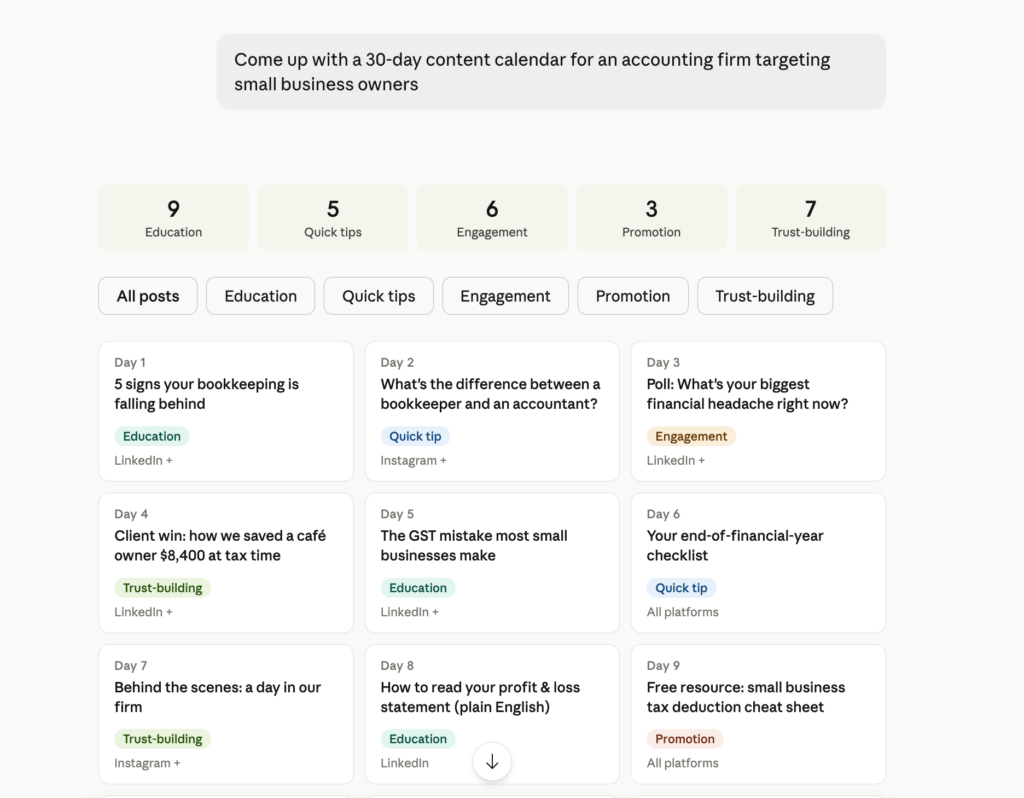
Again, here’s where I use Claude AI for content-planning inspiration. It’s great for brainstorming topics, generating ideas, and organising your calendar. For example, I’ve prompted it to create a 30-day content calendar for an accounting firm, and here’s what it provided.
Action step: Plan your content for the next 30 days. Don’t overthink. Just get something down on paper (or screen). You can adjust as you move along.
Step 5: Create Thoughtful, Well-Researched Content
Your content is as important as everything you have planned earlier.
You know your business best. What are your skills? If you are a plumber, you may be quick to solve a problem with your tools. Use this advantage to make your content more personal and build on it to garner more interest.
A note on AI: If you use ChatGPT to churn out generic blog posts, you will be no different from your competitors. Your content may look good on the surface, but it will have zero substance.
In fact, I’ve written an entire blog on this: The Risk of AI-Generated Content

Good content builds trust, positions you as the expert and brings in customers.
How to create thoughtful content:
Address your customers’ pain points by solving a problem they have.
Never stray from your brand identity. If you’re the warm, supportive expert, do not switch to being corporate and cold.
Provide real value with useful information. Keep away from fluff and fillers.
Action step: Before publishing anything, ask yourself, “Does this solve a problem or answer a question my customers have?” If the answer is no, don’t publish it!
Step 6: Track What Works (And Do More of It)
You need to know what’s working and what’s not. This will help you to create effective posts.
What to track:
Posts that get the most engagement (Likes, comments, shares, saves)
Blogs that bring in the most traffic (Check Google Analytics)
Content that leads to enquiries or sales? (Ask new customers, “How did you find us?”)
How to track:
-
- Social media insights (use their built-in analytics)
-
- Google Analytics (track the website traffic and user behaviour. Which pages do users stay on?)
-
- Google Search Console (check the keywords you rank in and the pages that get clicks)
Adjust your content based on the results:
If your “how-to” posts get more engagement than your promotional posts, create more of what works. If blog posts about pricing bring in enquiries, write more of them.
Action step: Review your content’s performance monthly. Take note of what worked and adjust your plan accordingly.
Bonus: Don’t Ignore SEO and AEO In Your Content
Do you know thatInstagram posts show up on Google now? Do you also know that 90% of informational searches in Google have Google AI Overviews?
SEO (Search Engine Optimisation) allows your content to be discovered on Google. Meanwhile, AEO (Answer Engine Optimisation) structures your content so that AI tools (like ChatGPT, Perplexity, or Google’s AI Overviews) can easily extract and quote it.
Both increase the visibility of your content. So if you’re updating and building content, working with an SEO copywriter in Perth to improve your search results is like killing two birds with one stone.
Developing a Content Marketing Strategy: Your Action Plan
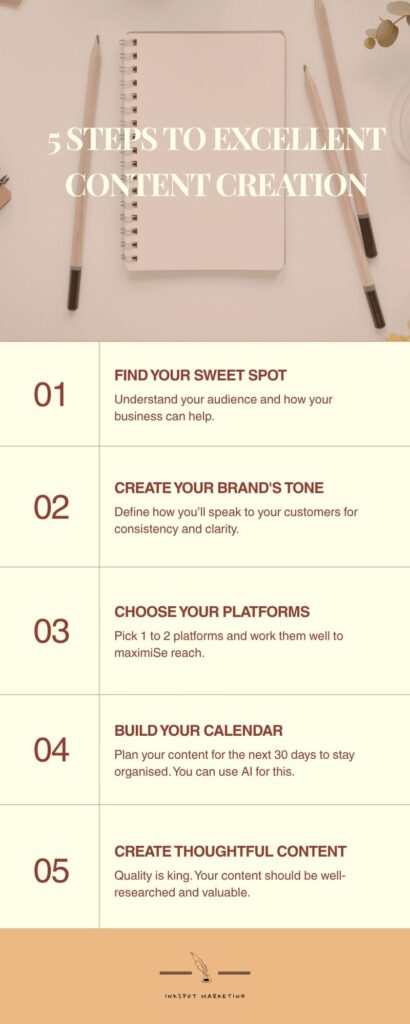
Alright, let’s recap.
As a final piece of advice, start small and stay consistent. Don’t try to do everything at once. In my experience with marketing, a simple plan executed consistently will always beat a complex one that never happens.
If you need help developing a content marketing strategy for your small business in Perth, let’s have a chat. I work with small businesses to create content marketing strategies that actually bring in customers, without the $1k ad spend or the complicated jargon.
Packages start at $449/month. No long-term contracts. Pause anytime.
Frequently Asked Questions
What is a content marketing strategy for small businesses?
Content marketing for small businesses is a plan for creating, publishing, and distributing content that attracts your target audience and turns them into customers. It includes understanding your audience, choosing platforms, planning content, and tracking results. This plan will create a good brand identity and presence for you while gaining the trust of customers.
How do I create a content marketing strategy in Perth?
Start by talking to your audience to understand and find your “sweet spot” (what they need combined with what you offer). Develop your brand’s tone of voice, choose one to two platforms to focus on, create a content calendar, and produce thoughtful content that addresses pain points. Track what works and adjust your plan accordingly.
Do I need a content marketing strategy if I’m a small business?
Yes. Without a strategy, you will be wasting your time and money on content that does not bring in customers. A simple plan keeps you focused, prevents overspending on ads, and ensures your content actually brings in leads and sales. It will also develop your brand’s tone of voice and give you constant exposure. Consistent content will also make customers believe more in you.
How much does it cost to develop a content marketing strategy?
You can develop a basic strategy yourself for free using the steps in this guide. If you hire someone, expect to pay $500- $2,000 for a professional content strategy. At Inkspot Marketing, we offer affordable strategy and execution packages for Perth small businesses.
What should be in a content marketing strategy?
Your content marketing strategy should include audience research, your brand’s tone of voice, platform selection, a content calendar, content creation guidelines, and performance tracking. Be sure to focus on quality over quantity and stay consistent by posting consistently.
How long does it take to see results from content marketing?
Most small businesses see initial traction within 60 to 90 days, if they are consistent. You will see meaningful results (consistent leads and traffic) between 3 and 6 months. Remember that content marketing is a long-term strategy, not a quick fix.

Denise Choong
Author
Denise is a small business marketer and copywriter in Perth, and the founder of Inkspot Marketing. With over 10 years of marketing experience, she’s worked with businesses in SaaS, finance, NDIS, medical, hospitality, and other industries.
Denise is passionate about using sound marketing practices to help business owners see tangible results in their investment. More than quick short-term wins, she works closely with businesses and marketing teams to see long-term, lasting growth.