

In 2024, Google launched its AI Overviews powered by its very own Gemini AI. This has since changed how consumers search (and buy).
AI Overviews are different from AI Mode, which is a newer and more advanced AI-driven search experience introduced by Google in 2025.
For many businesses and marketing agencies, it means less website traffic (which can be scary). It also means that many businesses now need to work harder and come up with new strategies in optimising content for Google AI Overviews – if they want to stay visible.
Here’s the fun part: Optimising your content for AI is a mix of keyword research, technical updates, and writing better, clearer, more useful content that both humans and AI can understand. You may notice that these tasks are not much different from typical SEO copywriting.
And honestly? That’s what good content has always been about.
TL;DR (Summary): To optimise your content for Google’s AI Overviews, answer the search query directly and get straight to the point. Your content should also be original, useful, and show your real expertise. Avoid relying solely on AI to write your blog, and structure your H tags so that they become a question instead of a statement and focus on the keywords. Lastly, do not over-optimise; you should always write for humans first and Google second.
Why Google AI Overviews Are Changing SEO
Google AI Overviews work by scanning multiple sources when you search for something online. It then extracts the most relevant information and presents it as a summary at the top of the search results.
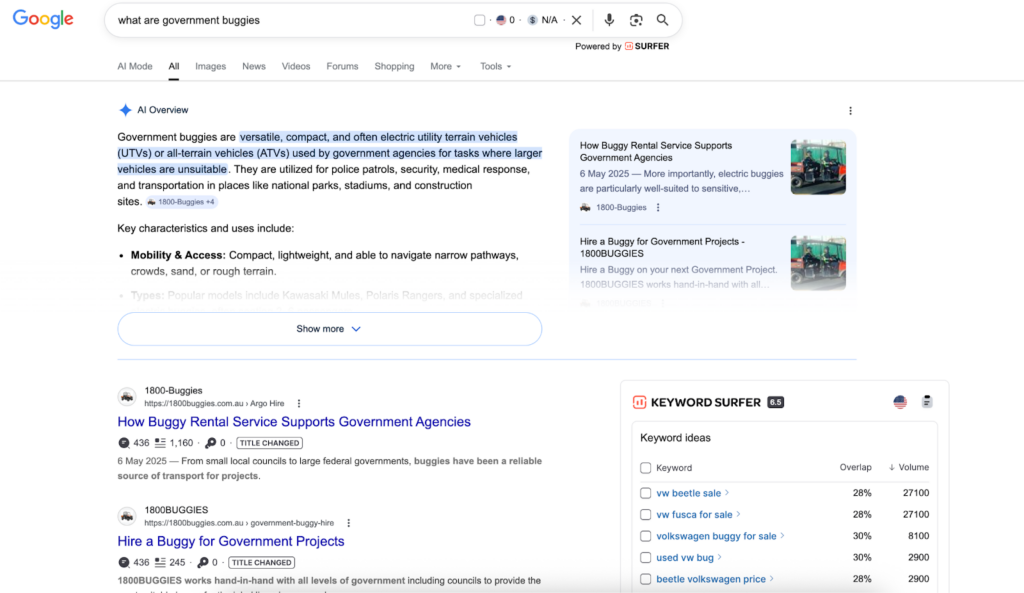
For example, here’s a company that I write for. Search for ‘what are government buggies’, and you’ll see Google’s AI Overview answer, along with their website referenced multiple times.
The website also appears at the top spot on Google Search.
If your business wants these results, it takes hard work and consistency (and working with a proficient SEO copywriter in Perth). Because of AI Overviews, it’s no longer enough to simply rank No. 1 on Google (the traditional SEO approach). Customers aren’t looking for links; they are looking for answers.
According to Search Engine Journal, AI overviews appear in over 99.9% of informational queries. When customers are looking for information, particularly those with a question as shown above, they are most likely to get AI overviews rather than traditional links.
So what does it mean for your business? Start optimising your content by creating blogs, website pages, and social media posts that answer questions directly, show real expertise, and don’t waste readers’ time with fluff.
Google has always pushed for its E-E-A-T principles of creating content (Experience, Expertise, Authoritativeness, and Trustworthiness). If your content demonstrates that you actually know what you’re talking about (not just repeating what’s already out there), you’re more likely to be picked up by Google’s AI Overviews.
10 Strategies for Optimising Your Content for Google’s AI Overviews
Strategy #1: Answer the Search Query Immediately
AI loves direct answers, so always get to the point and answer what customers are searching for. Don’t bury the point three sentences down. Instead, answer the question in the first sentence itself.
For example, if someone searches “how much does website copywriting cost,” here’s what you should write in your content:
✅ “Website copywriting in Perth typically costs between $500–$2,000 for a homepage, $300–$800 per service page, and $3,000–$10,000 for a full website package, depending on the copywriter’s experience and the scope of work.”
Here’s what you should NOT say
❌ “Website copywriting is a highly nuanced and specialised skill for copywriters, taking much of the copywriter’s time and resources. The pricing depends on your brief, but it typically costs around $500–$2,000 for a homepage, $300–$800 per service page, and $3,000–$10,000 for a full website package.”
See the difference? The first is clear, specific, and answers the query directly. Think of your readers as time-poor. They just need you to get to the point.
Strategy #2: Use Search-Intent-Focused Headings
Your headings should match how people actually ask questions. For example, if you’re an accountant, instead of writing a blog title that says “Understanding Self-Managed Superannuation Fund”, consider changing your title to “What is a Self-Managed Superannuation Fund?”
Also, have question-based H2 and H3 tags in your blogs and website content to make it easier for Google’s AI to scan your content (it also helps Google understand what you’re answering).
You never want Google to guess what your content is about. So think of your headings and titles like signposts that guide Google to your answer.
Strategy #3: Write in Clear, Human Language
Sound as human as possible when you write your content. Gemini prefers conversational, natural writing over jargon-heavy writing. So the other tip is to write like you’re talking. Use simple words, casual sentences, and a tone that feels human.
I always find this an interesting paradox – that an AI does not like content that sounds robotic. Google’s AI Overviews will not capture content written by AI. So if you’re using ChatGPT or Claude to write your blog and website content, be careful, and always add your own thoughts and insights to the mix.
Which brings us to our next point.
Strategy #4: Show Your Experience and Expertise
Gemini prioritises sources that show real experience and original insights. So your content should be highly specialised, focusing on insights and experiences that only you, as a business owner, have.
I heard this quote on The Diary of a CEO podcast: “AI can tell you all about menopause, but it cannot tell you its experience with menopause.”
Always remember that people buy from people, and Gemini knows this. Your content should be as personal and valuable as possible. Use real examples, share first-hand insights, and back up your points with opinion or data. Generic, fluffy advice is not the way to go.
Strategy #5: Optimise Content Structure for Scannability
AI doesn’t read, it scans. Make your content easy to scan by using:
- Short paragraphs (2-3 sentences max)
- Bullet points and numbered lists
- Tables for comparisons or data
- Clear subheadings
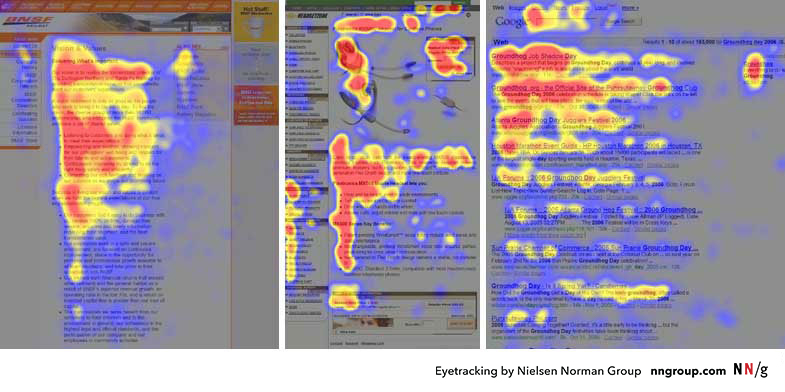
As mentioned in a previous blog article on writing a great landing page website copy, studies from Nielsen Norman Group discovered that readers tend to read in an F-pattern. Include important keywords at the front of your sentence, while also keeping it short and scannable for AI and humans to read.
Strategy #6: Build Content Around Customers’ Questions
Your content should always answer customers’ questions, and this is even more important with Google’s AI Overviews.
FAQ sections are perfect for this. Write FAQs that directly answer common questions in 50-100 words. These structures make it easy for AI to pull clean, quotable answers.
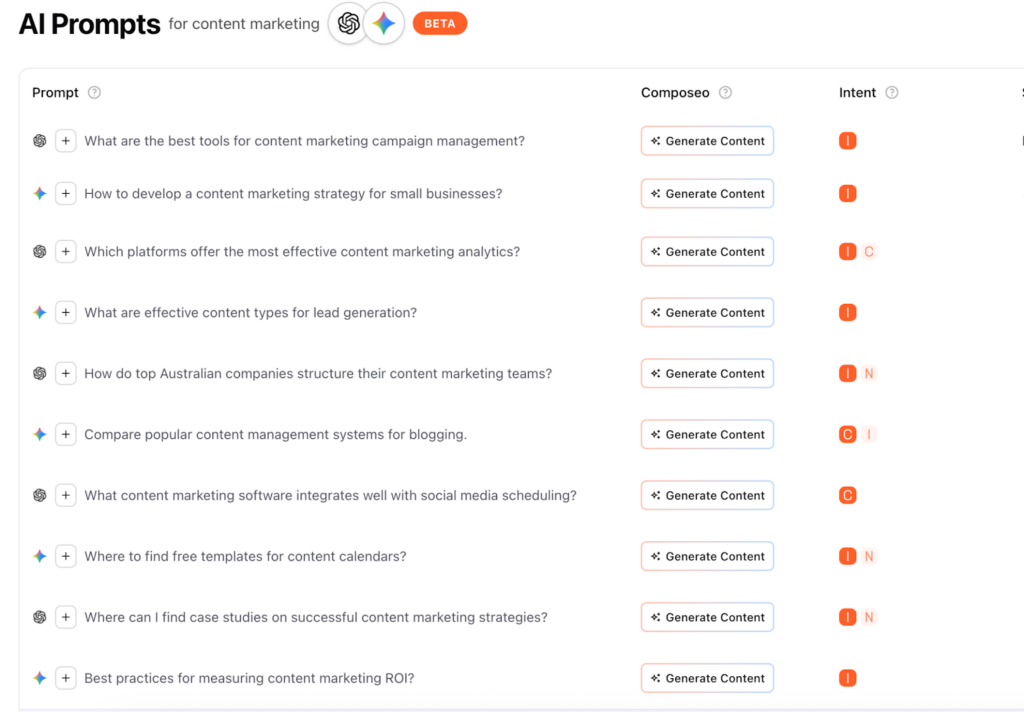
Consider adding FAQ sections to your website pages, and then fleshing them out with longer-form blog posts. I use AnswerThePublic to find out what customers are asking about in my industry niche, and then build a content framework around it.
For example, here’s what it came up with when I searched for customer questions around ‘content marketing’.
Strategy #7: Focus on Originality Over Automation
AI-generated content is everywhere now that there’s even a term for it – AI Slop. Big companies like Meta and YouTube have already acknowledged it’s a problem after much public outcry.
And if you need further convincing, here’s what Google says about AI content
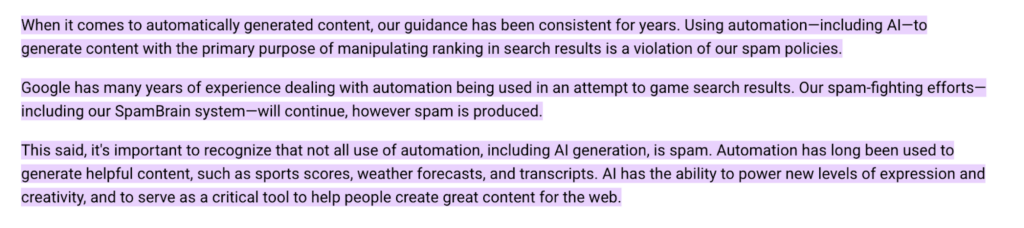
Source: Google Search’s guidance about AI-generated content
If you’re using AI tools to write your content (which is fine for drafts), make sure you’re adding original insights, real examples, and your own unique perspective. Templated, AI-written fluff won’t get quoted. Original, thoughtful content will.
If AI already has your answer in its database, how will you ever get it to rank your website with regurgitated AI content?
Strategy #8: Strengthen Internal Linking and Topical Authority
Google’s AI uses internal links to understand your expertise. Plus, the more you write and expand on a topic, the better Google thinks you are an expert on the subject matter.
For example, if you’re an accountant with a specialisation in Self-Managed Super Funds, build various content and blogs surrounding that. Use the ‘Who, What, When, Where, and How’ method to help you build your blogs.
Another good tip I have here is to use tools like Claude AI. Ask Claude to help you build out content clusters and blog topics that can help you show your authority.
Strategy #9: Avoid Over-Optimisation
Over-optimisation is the act of adding too many keywords or too many headers with all question marks, rather than using natural sentences.
For example, if one of your blog headers goes: ‘What is Content Marketing?’
And your sentence beneath it continues with “So what is content marketing? Content marketing is the act of marketing using content such as website content, social media content, and other forms of digital content”
This is highly unnatural. Your human readers won’t like it, and neither will Google.
Google’s AI is smart enough to understand context. Write naturally. Use word variations and synonyms. Focus on answering the question well, not on hitting a keyword target.
Always write your content for humans first and Google second.
Strategy #10: Add Clear Summaries and Takeaways
AI loves summaries (which is why my blogs always have summaries at the top). They make it easy to extract key points without reading the entire article. You should also consider having a key takeaway section at the end of your blog in bullet points. This gives the AI (and readers) a quick, digestible overview.
Here’s an example for you.
Key Takeaway
In short, here’s how you optimise your content for Google AI Overviews.
- Answer questions directly in the first sentence
- Use question-based headings
- Write like a human, and never use AI-generated content
- Show your real-world knowledge, experience and expertise
- Structure content with lists, summaries, and short paragraphs
- Focus on originality, and answer your customers’ questions through FAQs and blogs
AI Loves Good Content. So Do Your Customers.
Google AI Overviews aren’t about finding a secret formula. They’re about writing clearer, more useful, more original content. So answer questions directly, use simple language, show that you know your stuff, and structure your content so it’s easy to scan.
If you do those things, you’ll rank better in traditional search AND get quoted by Google’s AI. It’s a win-win.
And if you haven’t updated your existing content for AI search, now’s the time. If you need help optimising your content for Google AI Overviews, I work with Perth small businesses to create content that ranks on Google, sounds like them, and sells to their customers.

FAQs
What are Google AI Overviews?
Google AI Overviews are summaries that appear at the top of search results whenever you search for something on Google. These are AI-generated summaries powered by Google’s Gemini. It pulls information from multiple sources (websites, social media, videos) to answer a searcher’s query. Unfortunately, this also means that readers are no longer clicking on websites.
How do I optimise content for Google AI Overviews?
Optimise your website content by writing in conversational language, structuring your H tags into questions, and answering questions directly in the first paragraph. Focus on writing for your customers first instead of Google’s AI, and always give your own input and experience to your content so it’s original. Never use only AI to create your blogs, as it won’t get picked up by Google.
Is traditional SEO still important with AI search?
Yes. Traditional SEO tactics like keyword research, internal linking, backlinks, adding schema, local SEO, and mobile optimisation still matter. Optimising for Google’s AI Overviews has very similar strategies to your typical SEO strategies, so it makes SEO even more important than ever.
Does AI-generated content rank in Google AI Overviews?
AI-generated content can rank, but only if it’s original, well-edited by a human, and shows your real thoughts and expertise. Generic, templated AI content (otherwise known as AI slop) won’t perform well, as these insights are not unique. If AI already has the answers, why would it choose your content if there’s nothing new to source?
What is Answer Engine Optimisation (AEO)?
Answer Engine Optimisation (AEO) is the practice of optimising your content so that AI-driven search engines like ChatGPT, Claude, and Gemini can easily find it. Unlike traditional SEO, which focuses on ranking pages, AEO focuses on getting your content quoted in AI platforms. This is highly important considering customers now use AI to find answers instead of Google.

Denise Choong
Author
Denise is a small business marketer and copywriter in Perth, and the founder of Inkspot Marketing. With over 10 years of marketing experience, she’s worked with businesses in SaaS, finance, NDIS, medical, hospitality, and other industries.
Denise is passionate about using sound marketing practices to help business owners see tangible results in their investment. More than quick short-term wins, she works closely with businesses and marketing teams to see long-term, lasting growth.